Crane Transport in Brisbane & South East Queensland
Brisbane Low Loaders moves cranes of every class across SEQ — from Franna pick & carry cranes on machinery floats to large crawler cranes and lattice booms on multi-axle low-loaders. Every move is quoted to the crane, the corridor and the site access, with permits and route surveys handled in-house.
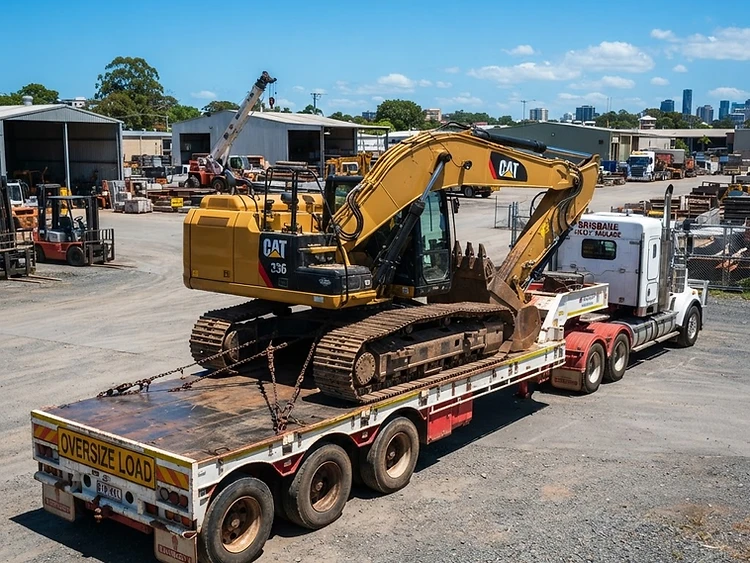
Specification
Trailer
Low-loader · multi-axle
Loading
Crane-assist · winch · drive-on
Permits
NHVR access (oversize/overmass)
Corridor
Brisbane · Gold Coast · Sunshine Coast · Ipswich
Crane transport is one of the most demanding heavy machinery movements across Brisbane and South East Queensland. Construction contractors, infrastructure crews and lift specialists rely on cranes — from compact Franna pick & carry units to large crawler cranes with lattice booms and heavy counterweights — and each class demands a different trailer, loading method and route plan. Brisbane Low Loaders engineers every crane move individually, matching the deck to the crane and the corridor to the load.
The right trailer depends on the crane’s class, operating mass and how it travels. Franna and pick & carry cranes, all-terrain and rough-terrain mobile cranes typically move on a machinery float or low-loader, often driving on under their own power where site access allows. Crawler cranes ride on multi-axle low-loaders, where the low deck height keeps tall machines within bridge and powerline clearance and the axle spread manages overmass counterweights. Large lattice booms, counter-jibs and mast sections travel on dedicated boom trailers or jib extensions matched to the load length and bearing — sometimes as a separate convoy component.
Oversize and overmass crane moves require NHVR access permits in Queensland once the loaded combination exceeds the statutory dimension thresholds — most commonly 2.5 metres wide, 4.3 metres high or 19 metres long. A crawler crane with a long boom or wide carrier often pushes past width and length limits on its own. Permit lodgement, pilot vehicles, escorts and route surveys are coordinated in-house as part of the quote. Brisbane Low Loaders surveys the SEQ route — the Gateway Motorway, Ipswich Motorway, M1 Pacific Motorway and Bruce Highway corridors — for height, width, mass and turning paths before the convoy moves, including tunnel height checks for the Gateway, Clem7 and Legacy Way.
Site access is where crane moves succeed or fail. Gate widths, overhead clearance, ground bearing and turning paths at both ends determine which trailer can reach the crane. A fully loaded multi-axle low-loader that cannot turn into a narrow construction site may need a different approach or a staged delivery of disassembled components. Soft ground and slope affect whether the crane can self-load or needs an assist crane. Brisbane Low Loaders asks for site photos and access notes as part of the request, surveys the route, and matches the trailer and loading method to the real conditions on the ground — not a default booking.
Crane types we move
Loading methods
Multi-axle low-loader
Low deck height keeps tall crawler cranes and long booms within bridge and powerline clearance, with axle spread managing overmass counterweights.
Crane-assisted loading
A separate assist crane lifts crawler crane components, mast sections or disassembled booms onto the trailer where the unit cannot self-load.
Boom trailer / jib extension
Long lattice booms and counter-jibs travel on dedicated boom trailers or jib extensions matched to the load length and bearing.
How to prepare your crane move
Confirm the crane type, operating mass and overall dimensions — including boom length, counterweight and any disassembly.
Specify whether the crane travels fully assembled, partially dismantled, or as separate components (boom, counter-jib, counterweights).
Photograph pickup and delivery sites — gate widths, overhead clearance, ground bearing and turning paths.
Identify any slope, soft ground or confined access that affects which trailer and loading method can reach the crane.
Provide the preferred timing window, especially for oversize crane loads restricted to certain SEQ travel hours.
Quote-Only Guarantee
Crane transport — quoted to your machine and corridor.
Tell us the crane, the pickup, the delivery and the timing. We return a quote engineered to your load — no published rates, no generic list.